Voices | Editor, William Jensen
You’d think after so many years teaching southwestern studies, after a decade of reading and editing Southwestern American Literature, I would know more. The funny thing is that the more I read, research, and discover, the less I seem to know. Funny, huh?
What I keep learning (and relearning) is how many different voices and stories come from the region. There’s always another version of history, another community unspoken for. The tales are endless. The Southwest isn’t simple or easily defined. It’s wild and messy; sometimes it is filled with awe. Sometimes it is tragic. The landscape can be vulnerable or strong and stoic beyond belief. Who can speak for every rock, cactus, and lizard out there? Not me.
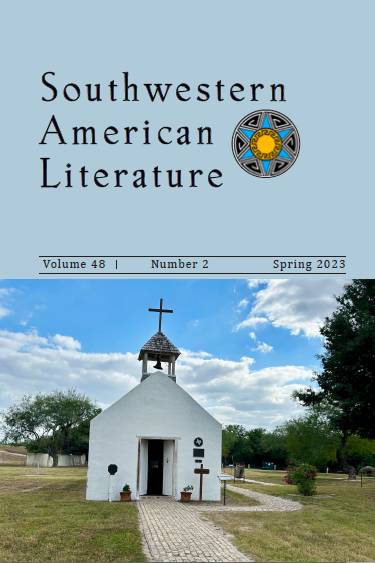
This issue of Southwestern American Literature is a testament to the cacophony of voices, peoples, and communities of the Southwest. There are poems, reviews, and scholarship about those who have lived (and fought) in a land consistently romanticized yet misrepresented. Erin Murrah-Andril delivers an excellent essay about gender within the writings of Américo Paredes. One of the best authors who captured life along the Texas-Mexico border, Paredes fought for remembrance of Mexican American heritage in a publishing world heavily controlled by Anglos. Decades after his death, his novels are more relevant than ever, and Murrah-Andril explains why. Poets Ryan Clark and Benjamin Green tackle the history of Texas and the greater Southwest while Emily Winakur, Beth Ann Mock, and James Lowell use language and imagery in their poems to go beyond stereotype and into the unknown dreams of the region. This issue also includes reviews of the latest books either set in the Southwest or focused on the area. Returning critic Shaula Schneik Edwards hops back into horror with her review of Matthew Lyons’s novel A Mask of Flies. Austin Hoeft also covers the gorier side of the desert with his musings on Hailey Piper’s Cruel Angels Past Sundown. Kiana Anderson tackles Woman of Light, the debut novel from story writer Kali Fajardo-Anstine, who dedicated readers know was first published here in Southwestern American Literature. Our own former editorial fellow, Cheyanne Clagett, gives her thoughts on Dinosaurs by Lydia Millet. Maria C. González and Kelsy Squire cover biographies with their reviews of La Plonqui: The Literary Life and Work of Margarita Cota-Cárdenas as well as Chasing Bright Medusas: A Life of Willa Cather. Sarah Venables takes on the challenge of exploring how writers represent the region for young adults in her review of Adrianna Cuevas’s The Ghosts of Rancho Espanto, and Laurie Lowrance gets into mystery and mayhem with her review of Anne Hillerman’s The Way of the Bear.
Southwestern American Literature is one drop in an ocean of writers, artists, and scholars trying to promote all that has and will happen in our beloved arid region. Here at the Center for the Study of the Southwest, our director and program coordinator tirelessly make readings and screenings and panels happen every semester. Just a few of our highlights include Dr. Alberto Giordano who spoke about migrant deaths at the Texas-Mexico border; Dr. Lina-Maria Murillo gave a talk about Chicana activism and reproductive care; and the former poet-laureate of Corpus Christi, Juan Manuel Pérez, read from his poetry and his songs. These guests and many others gave insight and hope to a region so many dream about and too few get to know beyond the surface.
I hope you enjoy the pages of our latest issue. I hope the words you read here inspire you and reaffirm something good in and around you. The Southwest is so much more than a lonely cowboy or a desperate coyote. The land is a place of the mind. It is a heart that beats stronger than you know. It is not just one singular voice but many because the Southwest is for everyone.