
Professor Jennifer Wilks | University of Texas at Austin
Thursday, March 26, 2026 | 2:00 PM
Theatre Building
Registration Required


Professor Jennifer Wilks | University of Texas at Austin
Thursday, March 26, 2026 | 2:00 PM
Theatre Building
Registration Required
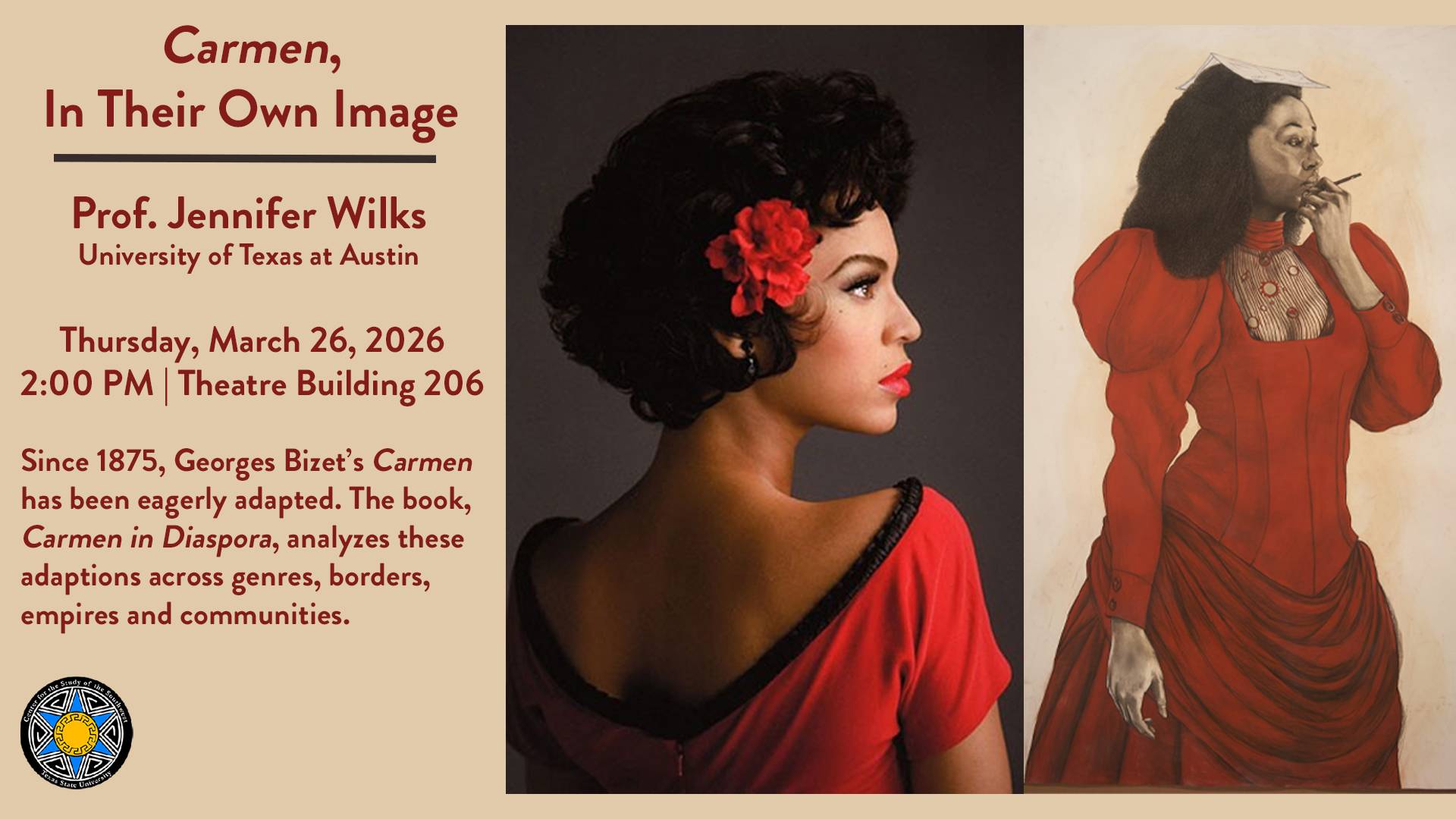
In 1875 France, composer Georges Bizet crafted a tangled tale about love, smuggling, factories, militaries and ill-fated relationships in Spain. Carmen, a Roma worker placed at the center of all the tangles, has invited audiences to question the choices and actions faced by women in difficult and subordinate circumstances, the importance of dignity under constraint, and the importance of style to working-class survival.
In her genre-straddling historically minded project Carmen in Diaspora, Jennifer Wilks tracks a fascination with Carmen – the woman and the opera – through the Harlem Renaissance, post WWII Hollywood, early Hip Hop, post-Apartheid southern Africa and our current re-stagings. As Wilks puts it in her discussion of Carmen adaptions in Senegalese and South African films, “Why are Karmen and Carmen—and the women in their circles—so dissatisfied with the status quo? Why does expressing that discontent ‘make waves.’” How do the preceding questions reflect changes in gender roles, or a lack thereof, between the creation of Carmen in mid-nineteenth-century Europe and the transposition of the story to Africa at the dawn of the twenty-first? These queries invite audiences to consider whether Carmen has become so popular over time because her story is so remarkable or because it is so relatable. Given the resonance between her insistence on freedom and the challenges still faced by modern-day women, she has become a new kind of everywoman as much as an icon.” These questions are there for us to understand why Dorothy Dandrige, Beyonce Knowles Carter, Lakesabe, and so many other interpreters have found themselves insisting on the importance of embodying Carmen.
Book Abstract
Carmen in Diaspora explores why the Carmen story, which originally appeared in Prosper Mérimée’s eponymous 1845 novella and came to prominence through Georges Bizet’s 1875 opera, has proven such fertile material for popular recreations in African diasporic settings. Carmen’s source texts not only suggest nineteenth-century French negotiations of blackness via the Romani community to which the title figure belongs but also provide provocative frameworks through which to examine conceptions of Black womanhood and self-determination in the twentieth and twenty-first centuries. Through analyses of Mérimée and Bizet; the Harlem Renaissance novels The Blacker the Berry (1929), Banjo (1929), and Romance in Marseille (2020); the US movie musicals Carmen Jones (1954) and Carmen: A Hip Hopera (2001); the Senegalese and South African feature films Karmen Geï (2001) and U-Carmen eKhayelitsha (2005), respectively; and the Cuban-set stage musical Carmen la Cubana (2016), Carmen in Diaspora examines how these works illuminate the cultural currents of the nineteenth-century European context in which the character was born and allow creators, performers, and audiences to interrogate social categories, particularly gender, race, and sexuality, in contemporary Europe, North America, Africa, and the Caribbean. It is an adaptation study that emphasizes connections formed through the transposition rather than imposition of European culture as it considers how artists have brought—and continue to bring—new energy, vision, and life to the story of opera’s most famous character.
Image credits
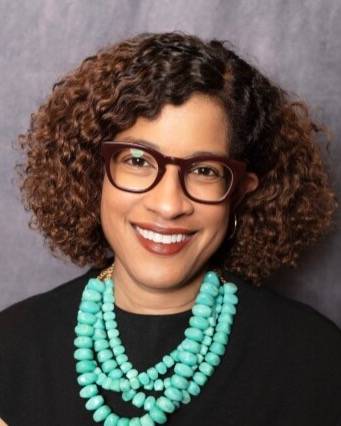
Jennifer M. Wilks is an Associate Professor of English, African and African Diaspora Studies, and Comparative Literature. Her latest book, Carmen in Diaspora: Adaptation, Race, and Opera's Most Famous Character (Oxford UP), is a cultural history of Carmen adaptations set in African diasporic contexts. Wilks is also the author of Race, Gender, and Comparative Black Modernism: Suzanne Lacascade, Marita Bonner, Suzanne Césaire, Dorothy West (Louisiana State UP, 2008), which explores the gendered constructs and legacies of the Harlem Renaissance and Negritude movements. Her essays have appeared in African-American Review, Callaloo, Comparative Literature Studies, Modern Fiction Studies, and Small Axe. Her translation (French to English) of the 19th-century French and Swiss diaries of African American activist Mary Church Terrell was published in Palimpsest. She is now at work on a study of representations of race and apocalypse in contemporary literature and culture. Wilks spent spring 2013 as a visiting associate professor at the Université Sorbonne Nouvelle-Paris 3 and spring 2006 as a visiting assistant professor at the Université Paris Nanterre. In 2013-2014, she served as co-director of the Texas Institute for Literary and Textual Studies (TILTS), whose theme was “Reading Race in Literature and Film.” In spring 2019, Wilks chaired Black Studies at 50: 1968/1969, UT’s second biennial Black Studies conference. Also an award-winning teacher, Wilks has been recognized at the department, college, and university levels for her work in the classroom.