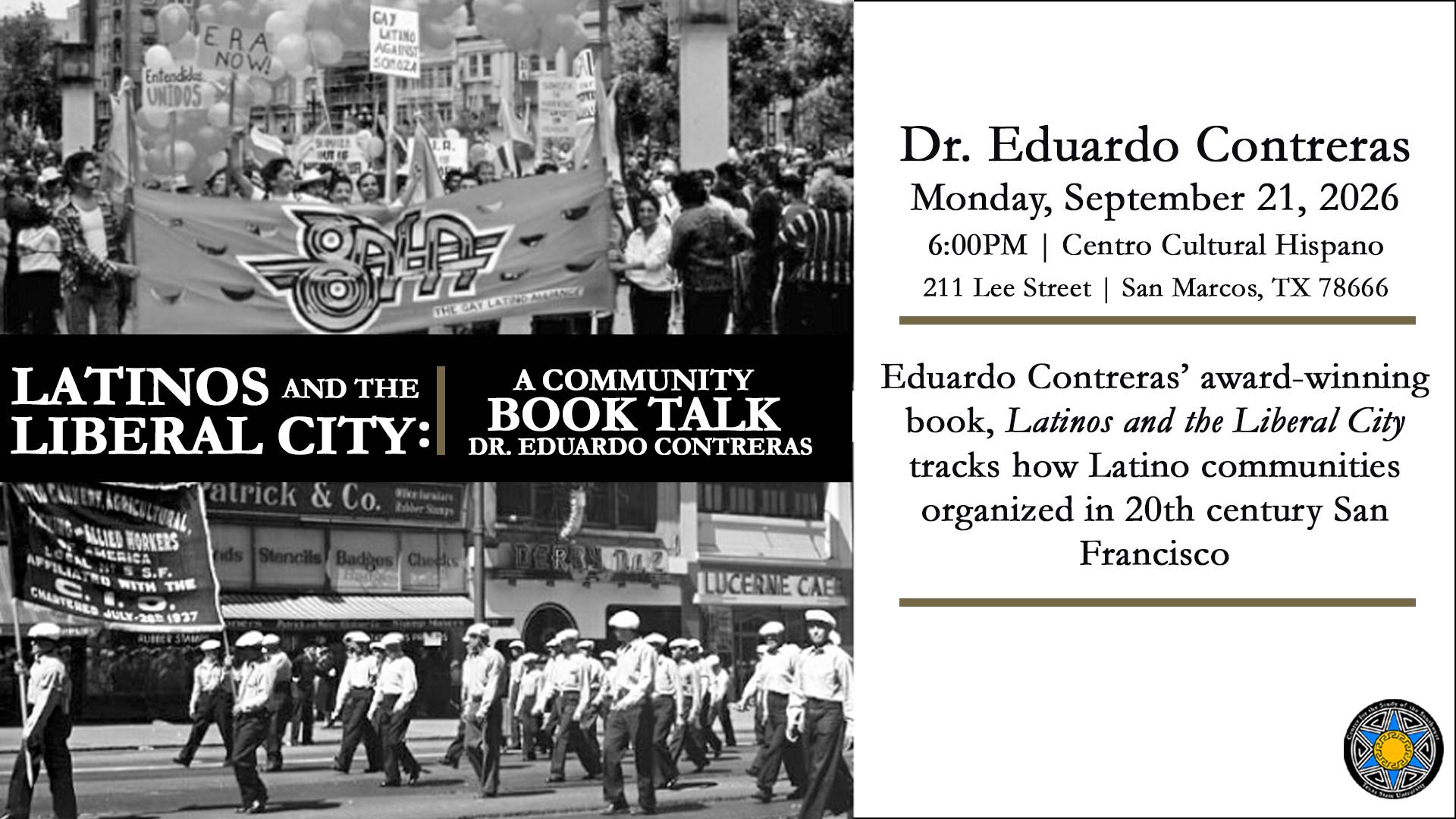
Eduardo Contreras tracks how Latino communities organized in San Francisco, arguing that attending to changes in liberalism and Latinidad is more helpful to understand political orientations and organizing.
In Latinos and the Liberal City, Eduardo Contreras offers a bold, textured, and inclusive interpretation of the nature and character of Latino politics in America's shifting social and cultural landscape. Contreras argues that Latinos' political life and aspirations have been marked by diversity and contestation yet consistently influenced by the ideologies of liberalism and latinidad: while the principles of activist government, social reform, freedom, and progress sustained liberalism, latinidad came to rest on promoting unity and commonality among Latinos.
Because of the Gold Rush, San Francisco and the Bay Area became the key economic hub for the West Coast through World War ii. Both an intercontinental rail hub and a key port linking cities across the Pacific, the Panama Canal and the East Coast. Latinos were among the many workers whose labor made the city possible, from work as sailors, fishermen, shipbuilders and cleaners, restaurant workers, farm workers, custodial staff, nurses and domestics.
After WWI, the push to make San Francisco sustainable to Latinas and Latinos sharpened, especially given their contributions through their labor to key industries and economies in San Francisco. This presentation examines the ways Latinas and Latinos sought improve the terms of their relationship to production forces in California, tracking this relationship from the vantage point of organizations – Alaskan cannery workers, service employees unions, public sector associations, community development centers that had Latinos and Latinas present and participating. This labor question framing is an original approach to ‘Latinos in the City,’ a key way in which Latina/o communities enter larger national narratives. This framing around the labor question helps move the historiographic discussion away from San Francisco exceptionalism.
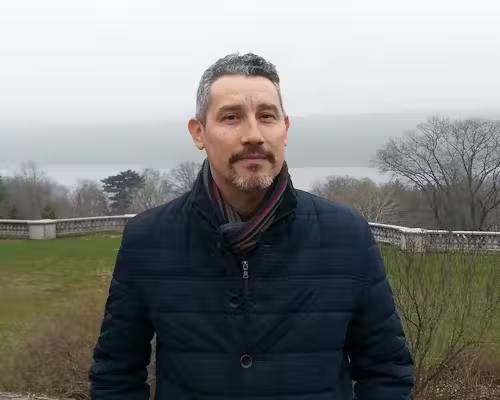
Eduardo Contreras is a historian of the United States and Central America. His research specializations include U.S. Latina/o/x histories, labor, race, and migration. He is the author of Latinos and the Liberal City: Politics and Protest in San Francisco (University of Pennsylvania Press, 2019). He's now at work on "North American Capital, Central American Labor: From the Gold Rush to the Early Cold War," an investigation of working people's responses to U.S. corporate enterprises in Central America since the mid-nineteenth century.
The first project, Latinos and the Liberal City, has garnered critical attention across a variety of fields. The American Historical Review concluded, “By focusing on trade unionism, feminism, gay rights, and other subjects, [Contreras] has gone far in explaining the liberality of San Francisco as something that Latino/as helped construct. And by bringing all these things together, he has produced a unique and important work.” A reviewer in the Journal of American History concluded that, “By placing Latinos at the center of the city's political history, Contreras allows us to see how generations of Latinos understood and attempted to shape the economic, social, and political systems around them.” In another revealing observation – perhaps more of the writer than of the book – Arizona History pointed out that “Without a doubt, Contreras demonstrates that San Francisco Latinos were politically active and helped shape this bastion of liberalism throughout the twentieth century.”
Broadly, scholars conclude with words like “essential reading for scholars of urban history, political history, and Latinx studies." “ an analytically sophisticated and archivally rich story of San Francisco and its Latino populations and traces in novel ways their engagement with the ideals and failures of twentieth-century democratic liberalism.” “ a standard bearer,” “a welcome addition to Latino/a history, western history, the history of labor activism, urban history, and other fields.”
Eduardo Contreras is also co-editing a special thematic issue for the International Labor and Working-Class History journal (ILWCH) on “Hot Work.” This issue will explore the meanings and experiences of labor in environments marked by heat, whether physical, industrial, or site-specific. Heat has long been a defining force in labor and working-class experiences. From the tropics to industrial foundries, and from colonial plantations to modern kitchens, “hot work”—as a concept and phenomenon—intersects with urgent questions about climate, inequality, and labor rights. This issue seeks to foreground these linkages to analyze how heat has defined work, shaped identities, and fueled struggles for justice.