Border and Migration Talks: Highlighting TXST Faculty Research
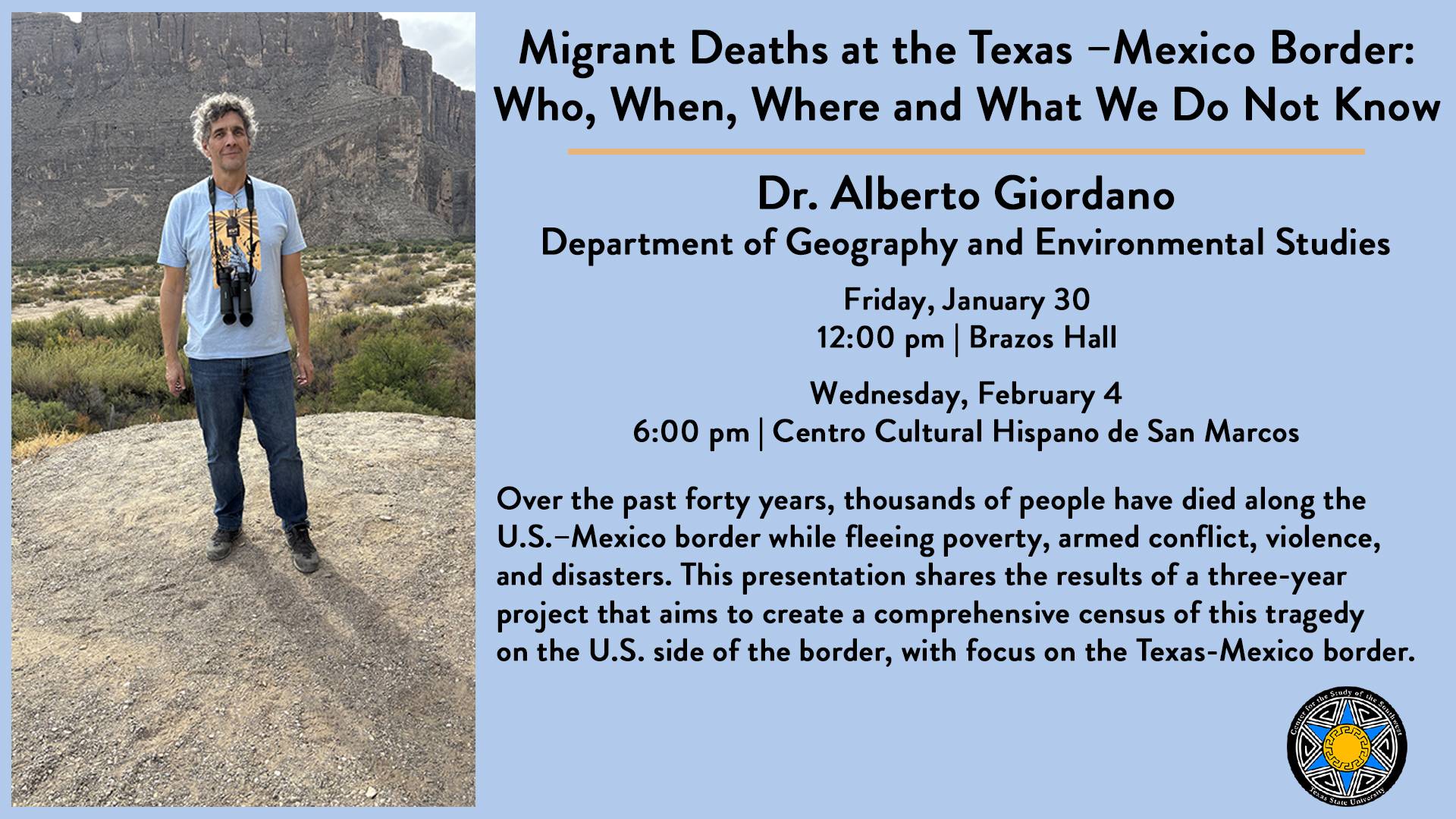
Migrant deaths at the Texas –Mexico border:Who, when, where and what we do not know
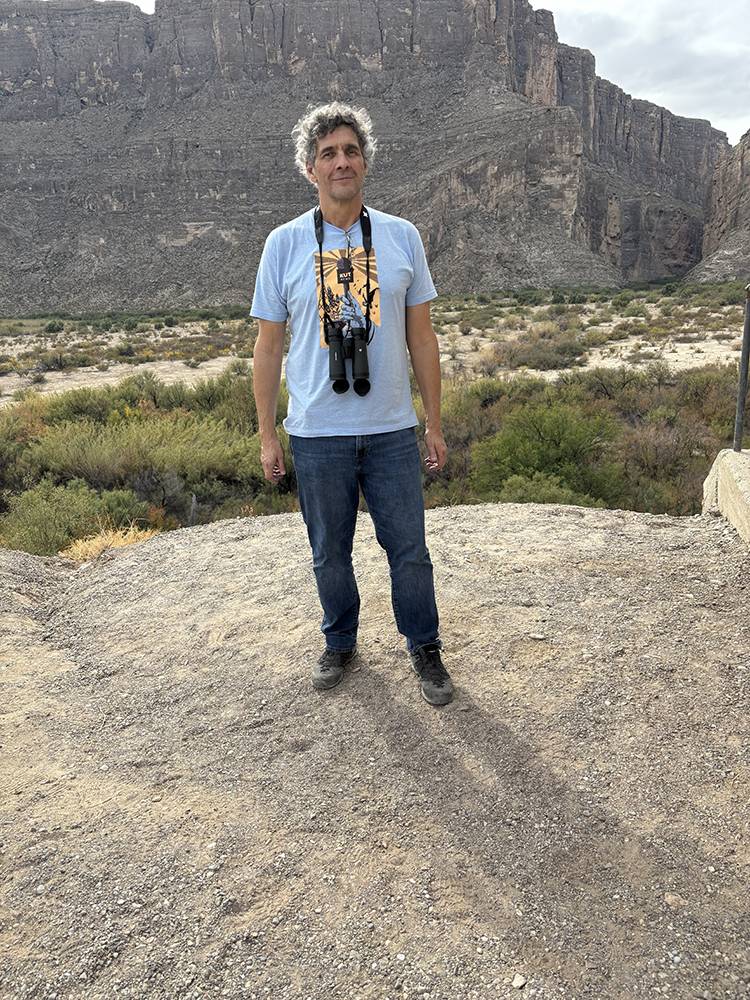
Dr. Alberto Giordano | Department of Geography and Environmental Studies, Texas State University
Friday, January 30 | 12:00 pm | Brazos Hall
Wednesday, February 4 | 6:00 pm | Centro Cultural Hispano de San Marcos | 211 Lee Street, San Marcos, TX 78666
Registration Closed
Over the past forty years, thousands of people have died along the U.S.–Mexico border while fleeing poverty, armed conflict, violence, and disasters. This presentation shares the results of a three-year project that aims to create a comprehensive census of this tragedy on the U.S. side of the border, with focus on the Texas-Mexico border. I begin with a brief history of U.S. migration policies as they relate to the southern border with Mexico, followed by a series of maps that visualize spatio-temporal trends in migrant deaths between 1982 and 2023. I discuss not only where deaths occur—often represented as “dots on a map”—but also the causes and manners of death, who finds the remains, which agencies (local, state, or federal) handle the cases, and the spatio-temporal patterns of these factors. I identify key obstacles to producing an accurate census, including differing state legal frameworks, overlapping jurisdictions, agencies’ reluctance to release data, and other institutional barriers. Local actors, including individual community members, often play an outsized role in determining whether deaths are documented at all. I conclude that establishing a more accurate count of migrant deaths is an essential first step toward understanding both the scale of this humanitarian crisis and the factors driving it.
Dr. Alberto Giordano is a Professor in the Department of Geography and Environmental Studies at Texas State University. He is a founding member of the Holocaust Geographies Collaborative, a network of researchers dedicated to applying geographical approaches, methods, and perspectives to the study of the Holocaust and other genocides. More recently, his work has focused on the intersection of geography and forensic anthropology, particularly the tragic deaths of migrants along the U.S.–Mexico border. He has also contributed to the history of borders and borderlands, including a recent project on the borderlands of the Grand Duchy of Lithuania in the 18th century.