


at Texas State University
The Ethics Bowl is a philosophy competition without the contention!
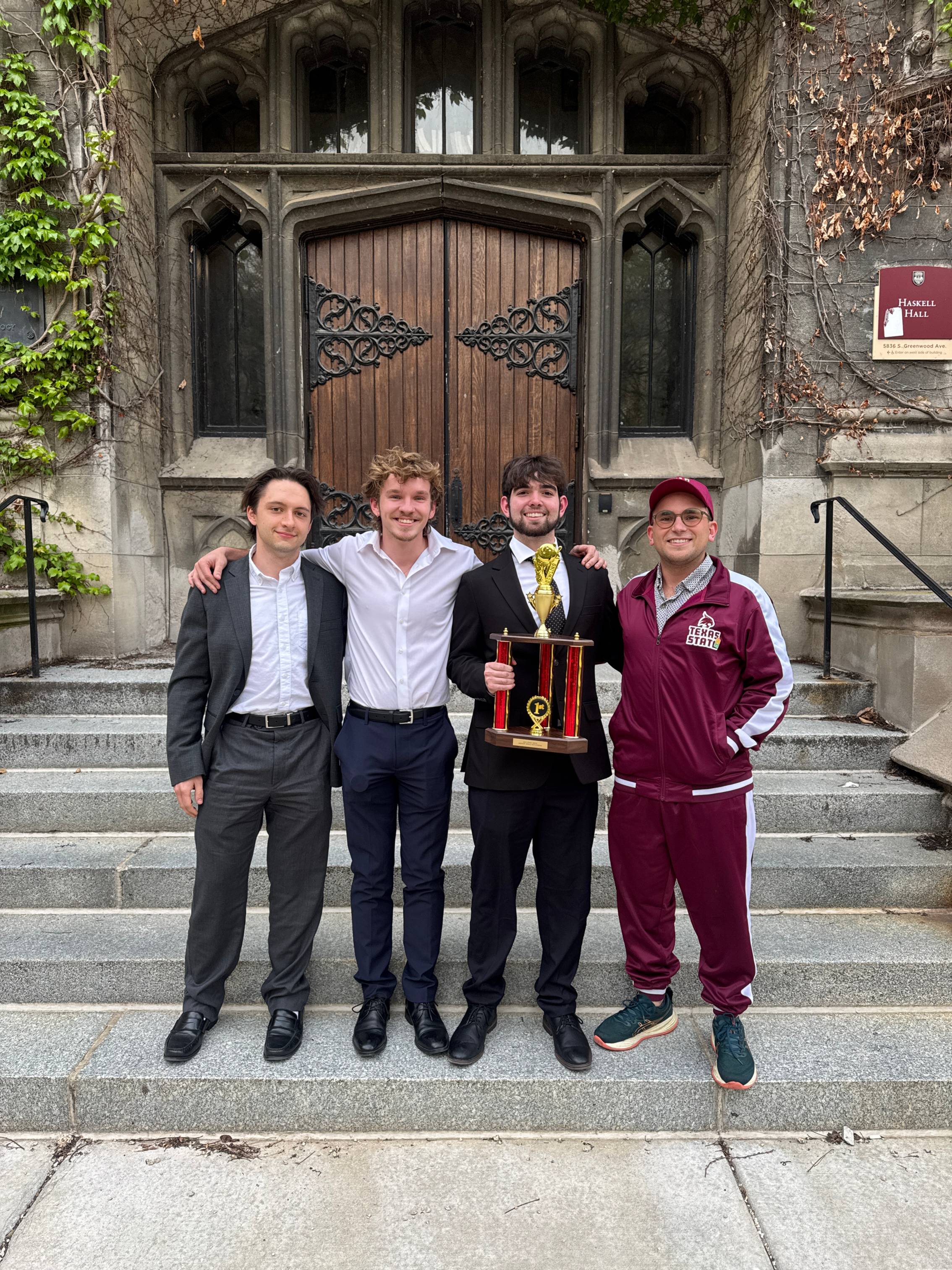
You, along with a team of other Texas State students, work together on real-world ethical problems in real time and represent TXST against universities from around the country in off-the-cuff moral thinking.
We are judged by our overall mastery of the ethical concerns in the difficult, and strange, ethical cases given. No need to be a philosophy major or ethicist—you just need to be curious.
Sounds interesting?
Check out more information about Ethics Bowl below.
So, Ethics Bowl…? How does it even work?
Ethics Bowlers receive a set of cases in early September that we as a team work on across the semester until the competition in mid-November where we are asked a specific (and difficult!) question about the case and must address, to which our opposing team will have time to ask us more questions, we try to think through their concerns fully, and then we face judges' questions.
So if it's an ethics bowl it’s about being right? Shouldn’t the answer be obvious, and what about when our team disagrees amongst themselves?
Sounds like a debate club in the philosophy department, and I’m not even a major…
No! Ethics Bowl is about showing how good of an overall grasp you hold over complicated ethical situations and ideas and can communicate that to others.
In-team disagreement is actually good, because it not only helps us see more angles of issues, but helps us see that others have different values as us--and then forces us to think through what that means too! In that way, it’s not ‘debate’ because it’s not about showing your position is more correct, but it’s about showing your team is more comprehensive in approaching the ethical concerns in play--and that's also how it's judged. And don’t worry, you don’t need to even be a philosophy major.
The more differences we have in the team, the better in fact!
Sounds interesting at least… how do the matches go? And how can I learn more?
Just like this.
An opening question, our response, the other team's response to ours, our rebuttal back, and a series of judges' questions. And to learn more?—continue below!
More about Intercollegiate Ethics Bowl
-
What’s a season look like?
Fall:September: Cases released, team comes together, weekly practices beginSeptember-October: we brainstorm, research, revise, and practice questionsOctober-November: scrimmages, more practice, and gather final thoughts on each caseNovember: Texas Regional Ethics Bowl!--Spring:If we qualify and advance…We head to and compete at the National Ethics Bowl at the APPE Conference!If we don’t qualify at the Texas Regional…We will try to find another competition or Invitational to compete at (should you wish to continue in Spring!) -
What are the cases like? Please review the Spring Invitational 2026 Case Packet for more information:
-
1. Historical Fanfiction
The idea behind the wildly popular Broadway musical Hamilton came to life after Lin-Manuel Miranda read an autobiography about Alexander Hamilton and resonated with his life story. The musical has been celebrated for allowing people of color to reclaim American history through its diverse casting. Additionally, Hamilton provides an innovative gateway for high school students to learn more about Alexander Hamilton and the founding of the United States.
Despite the education Hamilton can provide, some of Hamilton’s omissions may result in misinformation about history. The viewers of Hamilton who do no research beyond the musical itself may walk away with an overly romanticized perception of the Founding Fathers. As Hamilton dances around the issue of slavery, Alexander Hamilton appears to be a “staunch abolitionist” rather than someone with views toward slavery considered moderate at the time. However, if Hamilton had actively engaged with the tensions between ideals of liberty and the realities of the eighteenth century, it would have been a very different musical, and arguably would not have gained such immense cultural impact. Some may argue that it is unfair to criticize Miranda’s choice to focus on how Hamilton’s life story represents the American Dream and the theme of legacy. Part of making art is crafting a message. This often requires selective inclusion of events. Additionally, the medium of a musical has certain constraints to consider. Good musicals should have cohesive narratives and there is only so much time to pack in context and historical information.
Christopher Nolan’s Oppenheimer is another critically-acclaimed work centering around a historical figure’s life, winning 7 Oscars, including Best Picture. The film was a largely accurate depiction, although it took creative liberties in its nonlinear timeline and “fantastical imagery.” However, the movie faced criticisms that it glorified the atomic bomb, especially in Japan. Some felt the film would benefit from including Japanese voices. Oppenheimer also did not address the Native and Hispanic communities that were displaced because of the Manhattan Project. One could argue that this may be too much to ask for an already 3-hour long movie focused on one man’s life.
Some had similar concerns about A Complete Unknown, the 2024 biopic starring Timothée Chalamet as Bob Dylan. This movie depicts a fictionalized account of Bob Dylan’s life with the timeline altered and certain important individuals omitted or replaced with fictional characters. Dylan himself admitted to adding a “totally inaccurate" scene to the film. While this film does not concern itself with as contentious political topics as Oppenheimer, the film deals with the personal lives of many living subjects, and some say that that confers a responsibility to accurately portray those people.
Just last month, in February 2026, a new season of the popular Netflix show Bridgerton came out, a period drama set in Regency Era upper-class England. In particular, it presents the society as more sexually liberated and gives its main characters views that are more sympathetic to current-day politics, such as interracial marriage and queer relationships. The show, which has period-accurate outfits and makes a point of critiquing the social conventions of the time, might mislead vulnerable viewers into a historically inaccurate perspective, in particular of real-life characters such as Queen Charlotte. Historical fiction is a popular genre often because of its very malleability, but rarely does such content make clear its inaccuracies, leading to misrepresentation and often glorification of the past.
Is the narrative-shaping involved in converting historical events into a musical or film much different from traditional ways of teaching history? All history contains omissions. History textbooks are also prone to simplifying stories, such as who wrote the Declaration of Independence. While many students learn that Thomas Jefferson was the author, its writing resulted from a collaborative effort and stemmed from a larger, nationwide conversation about independence. Furthermore, the intended audience affects how history is described. An elementary school student may learn a more simplified version of events than a middle or high schooler because of where they are in their developmental process. History is compelling, so it's no surprise that artists portray historical events in their works. History education is difficult, so how artists choose to frame events may lead to very different results.
-
2. Shooting Up Skinny
Ozempic (semaglutide) was initially developed for people diagnosed with diabetes. However, Ozempic and similar medications have become widely used, not only for diabetes management, but also for weight loss. Many celebrities and influencers openly discuss their use of these drugs, and the medication has been hailed as a “miracle” for shedding pounds quickly. The 2026 Superbowl featured a prominent ‘Him & Hers’ advertisement, which lauded another weight-loss drug as “the future of healthcare” and a tool to “feel great in your body.” The rise of weight loss medications has increased public debates about body weight, obesity-related health issues, and beauty standards.
Proponents of weight loss medications believe they can improve overall health outcomes, pointing to the link between obesity and comorbidities like heart disease or diabetes. Apart from health, obesity can pose mobility and social challenges, and losing weight may improve general quality of life. The body positivity movement insists that health and self-worth should not be equated with weight. It argues that promoting weight-loss drugs may further stigmatise and isolate those who do not lose weight, and reinforce harmful beauty norms by suggesting that thinness should be prioritized and pursued at all costs. There are many reasons for not taking weight loss medication, including affordability, negative side effects, or simply not wanting to lose weight.
One concern highlighted by the body positivity movement is that the prevalence of weight loss medication will exacerbate medical discrimination toward overweight people. Primary care providers commonly report having less respect for obese patients, seeing them as “lazy” and “weak-willed,” and may assume their weight is the cause of potentially unrelated health issues.
There is also a question of resource allocation. The recent surge in demand for weight loss drugs exceeds manufacturing capacities, which has led to shortages. As a result, some patients who rely on semaglutide for diabetes management have had to turn to alternatives. The insurance coverage for semaglutide also varies, so wealthier patients have enjoyed greater access to semaglutide and to thinness.
The most extreme proponents of drug-assisted weight loss argue that insurance companies should cover semaglutide for all of their patients, while other proponents argue that it should only be available to those who need it. On the other extreme, many in the body positivity movement argue that, by having this drug available to patients beyond those with diabetes, we are medicalizing a social problem rooted in stigma and inequality. Weight loss already exists in a medically grey area, where it can be a healthy choice—or it can be deeply disordered. The availability of semaglutide makes that dynamic even harder to navigate.
This case was adapted for use from the Ethics Bowl Canada 2025 case packet.
-
3. A Sinking Feeling
In 2025, billionaire and CEO of Triton Submarines, Patrick Lahey, announced a 2026 expedition to explore the Titanic wreckage, to prove the merit of deep sea exploration amid an earlier accident in 2023 known as OceanGate. On Sunday, June 18th, 2023, five men embarked on a “once in a lifetime” journey in an underwater submersible to visit the wreck of the Titanic—nearly 2 miles underwater. This experience was made possible by Rush Stockton, the founder and CEO of OceanGate, a sea exploration company. Despite the company’s interest in “[sharing] with audiences around the world scientific and archaeological discoveries”, a seat in the submersible costs a quarter of a million dollars. The experience is supposed to last 10 hours; however, on that fateful day, the submersible was nowhere to be found. The story took the Internet by storm as the world wondered what had happened to the vessel. After a weekend during which the world held their breath, debris from the submersible was found. Further investigation suggests that the vessel imploded due to the extreme amount of pressure exerted from the ocean.
The attention from this incident kickstarted many discussions, not only about OceanGate’s safety oversights, but also about whether someone, as a tourist, should even be allowed to visit a site like the Titanic shipwreck. The sinking of the Titanic was an unbelievably tragic event claiming the lives of 1500 people—nearly 70% of whom were lower-class. OceanGate’s advertising seems to reduce the site—in which many people tragically lost their lives—to a novelty experience. Others were fine with the Titanic wreckage becoming a tourist attraction, however, critiqued the exorbitant price tag. Some rebutted that OceanGate eventually could lower the cost and make it a generally accessible experience for the public. In this way, people who feel a direct, or arguably social, connection to the sinking of the Titanic could engage with the actual event in a much deeper way. Further, making the Titanic a tourist site could help raise awareness about not only the lives that were lost in the event, but also the disproportionate wealth gap between the survivors and those that lost their lives. Still, others argue that it is more respectful to just leave the site alone.
OceanGate’s Titanic submersible and its current recreation is just one example of a controversial branch of tourism: dark tourism. Dark tourism brings people to sites where a great tragedy occurred. Auschwitz, Chernobyl, and Pompeii are all examples of tourist destinations that center around a great tragedy and loss of life. In fact, sometimes these sites are incredibly popular precisely because of their morbid nature. As philosopher Susan Feagin writes, “we receive pleasure from tragic events because we are pleased to find ourselves responding in an unpleasant way to human suffering and injustice.” Although there exists a plethora of theories about why exactly we engage with tragic or morbid events, our “dark” attraction is undeniable. There may be nothing wrong with entertaining this innate, morbid curiosity; however, using these sites as a means to entertain those interests could ultimately be seen as voyeuristic or disrespectful. On the other hand, others write that engaging directly with these tragic events in a respectful manner can help inculcate empathy for those that were negatively impacted in some way. Most importantly, stripping someone of the opportunity to visit these sites may create such a disconnect from the event that it is forgotten, or its importance downplayed.
-
4. An Unexamined Livelihood
In January 2019, Princeton held a conference entitled “The Future of Classics.” Classics Professor Dan-el Padilla Peralta stated that he believes Classics, the study of Ancient Greece and Rome, to be an inherently racist discipline. “If one were intentionally to design a discipline whose institutional organs and gatekeeping protocols were explicitly aimed at disavowing the legitimate status of students of color,” he declared, “One could not do better than what Classics has done.” The way in which US and European schools frame Greco-Roman history has implications both in academia and in the broader world. For example, the claim of descent from famous ancient Greeks is sometimes a contributing factor to racist and xenophobic attitudes towards refugees in Greece today. And in the US, Second Amendment rights are often upheld by the slogan “Come and get it”, which was a famous saying of the Spartans at Thermopylae, a battle glorified through a racist lens by the popular film 300.
This very phenomenon, however, has been one of the main arguments for the continued study of Classics. It is only, many Professors argue, by studying the facts that such abuse of history can be dismantled. For example, any Classics major knows that ancient Athens, widely called the birthplace of democracy, did not allow women, enslaved people or foreign residents to vote; enslaved war victims in deadly silver mines; and engaged in what might today be deemed institutionalized pedophilia. Engaging with these complications is important for refuting glorifications in the popular media, and for better understanding the history of values which some modern countries uphold.
And yet, however important the study of Greco-Roman civilizations may be, there remains the question of its framing. After all, it is an area of study, like East Asian Languages and Civilizations or South Asian Languages and Civilizations, aside from the notable peculiarity that it is defined by time as well as space, since it refers strictly to the study of antiquity. One could then argue that it might be better dubbed Ancient Mediterranean Studies, and that the title of “Classics'' constitutes a pedestal. This reflects the way that American and European schools often promote a Eurocentric worldview, making it difficult for students to view other cultures without a type of definition by contrast.
Most Classics scholars acknowledge these issues of racism and Eurocentrism; however, some practical factors bear keeping in mind. At least one clear purpose of every Classics department is teaching dead languages, keeping them known. It is rare for students to have the linguistic capacity to know many cultures equally. Additionally, there is an inherent imbalance regarding which ancient cultures can be studied, given that texts and artifacts have survived from the distant past to varying degrees. A society like Classical Athens, from which numerous texts survive, may always be disproportionately studied, due to the physical possibility of gathering evidence about it.
-
5. My Buddy and Me
During WWI, German physician Dr. Gerhard Stalling began to train guide dogs for blind veterans, opening the very first school for guide dogs. In 1928, Morris Frank was paired with a German Shepherd, “Buddy,” from a school in Switzerland, who helped him navigate the crowded and densely packed streets of New York City. After Buddy’s success, Frank and trainer Dorothy Eustis opened the Seeing Eye, the first American guide dog school, which is still in operation today. Guide dogs proved immensely helpful to blind people. They were able to regain their independence, navigating otherwise dangerous streets with the help of their new companions. In the 1970’s, Dr. Bonita Bergin began to train dogs to aid people with other disabilities, and the modern service dog was born.
Today, there are an estimated 500,000 service dogs active in the United States. They perform quite a few impressive duties. Seizure alert or response dogs are trained to predict seizures before they happen and to assist with mitigating an oncoming seizure. Hearing dogs signal deaf people about important sounds they cannot hear, like smoke alarms, door knocks, or distressed children. Sensory Signal Dogs are assigned to people with autism to help with navigating overstimulating situations, assist their person with exiting overwhelming places, or alert their person of “stimming” movements which may cause harm. Psychiatric service dogs can be trained to help people with PTSD, panic disorders, and other psychiatric disabilities by detecting panic attacks, reminding them to take medicine, and safely maneuver through or out of a triggering situation. These dogs are remarkably effective. A 2021 Department of Veterans Affairs survey, for example, found that veterans with PTSD service animals experienced better sleep, less suicidal ideation, and fewer overall symptoms of PTSD than their peers without dogs.
The ADA, passed in 1990, mandates that (with a few exceptions), service animals are allowed inside public buildings, businesses, restaurants, and hospitals, where animals are otherwise prohibited. Service dog handlers may not be charged pet rent or other fees associated with pets, nor refused service, even in case of dog allergies. Generally speaking, service dogs may go wherever the public goes.
However, some recent trends have complicated the lives of people with service animals. While the ADA stipulates that service dogs, by definition, must be trained to perform a task in support of a disability, there is no federally-recognized accreditation of training programs, nor any officially certified gear, such as a harness, which designates a dog as a service dog. Emotional support animals (ESAs), comfort dogs, and pets are not subject to the same ADA protections as service dogs, since they are not trained to perform specific tasks in the way service animals are. Yet, they often look like service dogs, and anyone can buy a harness labeled “Service Dog: Do Not Pet” on Amazon.
Some have argued that people with ESAs (who may or may not have a disability) are unfairly exploiting the system to avoid fees like pet rent or to take their dog with them wherever they go. Furthermore, since ESAs do not go through the same rigorous training programs that service animals do, they are often not well-behaved in public. Displays of aggressive behavior (such as growling, snapping, jumping, barking, or biting) towards people of other dogs jeopardizes others’ safety in public and, if directed towards a service animal, may force that dog to retire – and replacing a service animal is both costly and time-intensive. Such poor behavior also reflects poorly on service animals and their handlers, since it can be hard to distinguish the two on appearance alone. Additionally, these similarities result in employees and business owners wholesale refusing admission to any dog, or on the other extreme, admitting anyone with a dog for fear of legal action.
Others argue that anti-pet practices such as charging pet rent, requiring people to purchase tickets for their dogs at events and while traveling, and banning dogs from businesses is inherently unjust and, as such, it is not immoral to find ways around the system. Still others observe that many ESA handlers do train their dogs to behave well in public and argue that being a comforting presence is a passive service task which helps prevent panic attacks, and thus, ESAs ought to benefit from the same ADA protections as service dogs.
This case was adapted for use from the APPE Intercollegiate Ethics Bowl case archive.
-
6. Pay-to-Play – Hunting, Hiking, and the Environment
One of the leading causes of species endangerment is destruction of habitat. With a growing population that requires both increased housing and increased agricultural production, habitat destruction and endangerment is going to be an ongoing issue. With a growing population and increasingly threatened natural areas, conservation efforts are needed, and conservation efforts require funding.
In the U.S., including Oklahoma, hunting, fishing, and trapping permits are one of the primary funders of conservation efforts. Proponents of hunting point out that without hunting, many of these animals lack natural predators. This is often because the predators have themselves been hunted in an excessive manner and because of habitat destruction limiting their ability to range.
Put simply, conservation is often a pay-to-play model. Hunting, fishing, and trapping fund the efforts needed to keep the animals alive, which are then killed via hunting, fishing, and trapping. But by maintaining those habitats, other species are likely benefiting from the conservation because no animal lives in a vacuum. But this model has two notable downsides.
The first downside is that the number of hunters in the U.S. has been declining over the past 30 years, which means funding suffers as a result. To replace this funding, taxes could be used to fund conservation efforts instead of a fee-based structure, but that would mean either raising taxes or cutting public funding to other programs. For example, in Oklahoma, increasing taxes is difficult. For the legislature to pass a tax increase, it requires a three-fourths majority in both chambers of the state legislature or for the legislature to refer it to a direct vote by the people of Oklahoma. Since that policy was approved in 1992, only two revenue bills have successfully raised taxes, once by the legislature and once by the state’s voters.
The second downside is that the act of hunting is considered by some to be inherently cruel. Animal rights often prefer to let nature take its own course for controlling animal populations. This would mean letting wildlife populations ebb and flow without human interference. While hunting, fishing, and trapping have been declining, there are other users of natural spaces. This includes those who hike, go mountain biking, birding, kayaking, and so on. In other words, they also use natural space, but they do not kill the animals in the process.
States could create a pay-to-play model for these other outdoors activities, which could then be used to maintain natural areas. State parks in Oklahoma already require an entrance fee, but private landowners can also set their properties up as agritourism destinations. While that might increase space for wildlife, there is no guarantee that these efforts would be uniform within and across states, or that private landowners might not kill off species they consider to be problematic but are necessary for that local ecosystem to thrive. There also becomes a lack of centralized effort because landowners could take varying strategies, but fish and wildlife are not beholden to property lines. But a case could be made the landowners are going to know what is right for wildlife on their property and in their local area to thrive more so than policymakers in the state capital.
This case was adapted for use from the APPE Intercollegiate Ethics Bowl case archive.
-
7. Licensing Parents
In Denmark, new parents of a certain demographic are required to participate in a parental competence test, and in rare cases can lose custody of their newborns if they fail to demonstrate basic skills. Despite being banned since May 2025 after widespread criticism of the tests being racist and culturally insensitive, one young Greenlandic mother was recently separated from her newborn after failing her competency tests.
Some people have advocated for parental licensing. Philosopher Hugh LaFollette argues that parenting, like driving or practicing medicine, is a high-stakes activity, and should be treated similarly—poor parenting can cause lasting harm, yet society requires no demonstration of competence to become a parent. His point is simple: our society already regulates activities that could harm people, which carry far fewer risks than raising a child. We require licenses for activities like driving because safe use of a motor vehicle necessitates a level of competence. Certain professions like medicine, law, pharmacy, and psychiatry have licensing standards to ensure that practitioners are competent. LaFollette further argues that when moderately reliable tests are available, society should use licensing procedures to protect innocent people from incompetents. If the welfare of children matters most, why not ensure that parents are competent?
Still, the idea of licensing parents raises serious ethical concerns. What would the necessary qualifications be, and who would be best positioned to determine them? How will considerations of culture be included in the qualifications to avoid bias? Licensing risks unfairly burdening poor or marginalized families, or people from particular racial groups. The government removal of children from parents who originate from a cultural background differing from the country’s majority is reminiscent of Canada’s uniquely dark history with residential schools, where many children were separated from their parents in re-education programs that led to systemic abuse and neglect.
The care and affection of a parent is generally what children desire – not the ‘best’ or the ‘ideal’ parent, but their parent. But what if the parent needs basic guidance on how to keep children safe and healthy? Some suggest a less coercive alternative: mandatory parenting classes for all new parents, similar to driver’s education, which could equip families with basic skills without threatening their custody rights. Mandatory parental classes could ensure that all prospective parents are equipped with the basic knowledge and skills necessary to protect and promote their child’s welfare. Supporters say this would give every child a fairer start, while critics argue it still imposes unwelcome government oversight into private family life and would be hard to enforce. While most parents love their children and do an adequate job, the exceptions are tragic. Who should protect children from incompetent caregivers—and how?
This case was adapted for use from the Ethics Bowl Canada 2025 case packet.
-
8. Bombing Around the Bush
Though the idea of environmentalism in the U.S. tends to conjure images of tree huggers and hippies, the movement’s history—both here and abroad—has been as disruptive and bloody as any other. One of the most well-known recent demonstrations was the Dakota Access Pipeline protest, in which hundreds of indigenous tribes protested the construction of an oil pipeline through sacred lands that threatened the safety of their water supply. Protesters marched, chained themselves to bulldozers, and destroyed relevant capital (by setting fire to heavy machinery) to delay construction. In response, protesters were imprisoned, attacked by authorities, and even bitten by attack dogs.
Though environmental protests are largely nonviolent, they are not necessarily non-destructive. In the Dakota Access Pipeline protest, as with many other environmental protests around the world, protesters strategically destroyed property as a political tool to pressure businesses/governments into change without causing anyone physical harm. Such strategies are ancient tools for change, used in nearly any major social/political movement, from the Luddite movement28 in the 1800s to the famous Boston Tea Party of the American Revolution.
Despite the wide-spread nature of such tactics, some (including the US government29) believe these actions cross the line from peaceful protest into genuine harm. In covering destructive protests, many news channels characterize such activism as examples of vandalism, criminal activity, or even “eco-terrorism”. Others point to the economic ramifications of destroying private property, not just on those that own a given asset but also on the working-class employees hired to run and operate that capital. Finally, others worry that in condoning such activism, we risk normalizing destruction and encouraging a culture of violent protest.
On the other hand, activists vehemently oppose the characterization of their actions as “violent” or acts of terrorism. For instance, though the Dakota Access Pipeline protesters admit to damaging property, they argue that their protests were still strictly non-violent, since their tactics do not directly physically harm anyone. In fact, most protesters see themselves as preventing violence and harm by advocating against environmental damages that increase the deadliness of environmental disasters, destroy local biodiversity, and perpetuate climate disaster. When asked about accusations of eco-terrorism, Areas Malm, author of How to Blow Up a Pipeline responded: “If the word “terrorism” is going to have any kind of meaning, it’s the indiscriminate killing of civilians for the purpose of instilling fear. That’s very far from what I advocate.”
Whether actions taken by protesters are classified as violent or not, protest—particularly environmental protest—is becoming increasingly criminalized around the world. One analysis from researchers at Wesleyan University, for example, found that of the 175 grassroots environmental protests examined, over 30% were met with violent repression. More broadly, this trend of criminalizing protest appears to be taking place worldwide—in just one recent instance, peaceful protesters in Belarus were violently dispersed, resulting in unlawful detentions and even torture. Even in so-called “bastions of free speech”, this ability to protest is under attack—such as Atlanta, where over 40 “Stop Cop City” protesters were charged and arrested for “domestic terrorism” after attending a music festival supporting the cause. Many see such extreme repression as further evidence that effective protests against the status quo—whatever form they take—are more necessary than ever.
-
Wanna Go Bowling?
- Getting beneath the headlines?
- Figuring out why reasonable people disagree?
- Arguing without strawmanning?
- Thinking through difficult and strange moral issues?
- Working as a part of a team?